Morgan Friedrich · 24 September 2026
Soil Microbe Interactions in Arid Regions Offering Insights into Digital Content Archiving Techniques
Soil microbe interactions in arid regions demonstrate survival strategies that researchers now examine for applications in digital content archiving, where data must persist across distributed systems despite environmental stresses and potential failures. These dryland ecosystems, characterized by limited moisture and extreme temperature fluctuations, host communities of bacteria, fungi, and archaea that form intricate networks for resource exchange and structural stability.
Microbial Survival Mechanisms in Dryland Soils
Arid soils support microbial populations that endure prolonged drought through the production of extracellular polymeric substances, which create protective biofilms around root systems and mineral particles. Studies from desert research stations in the southwestern United States and central Australia document how these substances bind soil aggregates while facilitating the transfer of water and nutrients between distant microbial cells. Nitrogen-fixing bacteria such as those in the genus Azospirillum establish symbiotic relationships with sparse vegetation, converting atmospheric nitrogen into forms accessible to other organisms in the network.
Researchers have mapped these interactions using metagenomic sequencing, revealing that microbial diversity remains surprisingly high even when overall biomass is low. Data collected across multiple sites show that certain keystone species coordinate metabolic pathways during rare rainfall events, rapidly processing organic matter before it evaporates or is lost to wind erosion. This coordinated response allows the community to store energy reserves that sustain activity during extended dry periods.
Network Structures Supporting Persistence
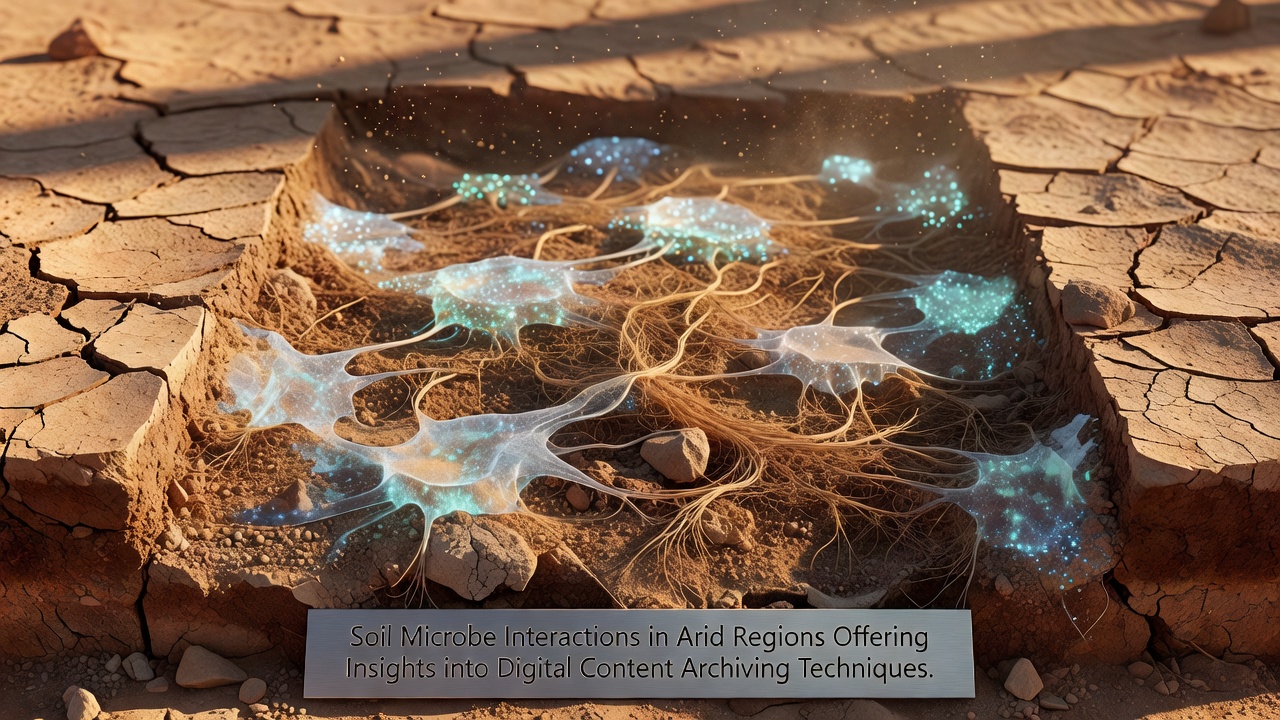
Observations indicate that microbial networks in arid regions operate through redundant pathways rather than linear chains, which minimizes the impact of individual species loss. When one bacterial population declines due to salinity spikes or heat stress, neighboring fungi and actinomycetes maintain nutrient cycling through alternative routes. Soil core samples analyzed in laboratories reveal dense hyphal connections that span centimeters, effectively creating living infrastructure for information and resource flow within the system.
Long-term monitoring programs initiated by institutions including the Desert Research Institute have tracked these networks over multiple seasons, documenting how spatial distribution of microbes correlates with soil moisture gradients. The resulting datasets demonstrate that clustered communities near plant roots exhibit higher interaction density than those in open interspaces, yet both contribute to overall ecosystem stability through different functional roles.

Translating Biological Patterns to Digital Preservation
Digital content archiving faces parallel challenges of maintaining accessibility over decades while coping with hardware degradation, format obsolescence, and organizational changes. Systems architects have begun studying microbial redundancy models to design distributed storage architectures that replicate data across multiple nodes without central points of failure. The principle of biofilm-mediated protection finds an analogue in encryption layers and checksum verification routines that shield digital objects during transmission or migration.
Projects exploring these connections draw on findings from arid zone ecology to inform algorithms for data placement. Instead of concentrating files in single repositories, the approach distributes fragments across geographically separated servers, much as microbial cells occupy varied microhabitats within the same soil profile. When one node experiences downtime, surrounding nodes continue to serve requested content through pre-established replication protocols.
Research Developments Through 2026
In September 2026, collaborative workshops between soil ecologists and information scientists examined quantitative metrics for network resilience, comparing recovery times after simulated disturbances in both biological and digital systems. Preliminary results presented at these meetings suggest that microbial-inspired sharding techniques can reduce retrieval latency while increasing fault tolerance in large-scale archives. Government agencies in Australia and the European Union have funded follow-up studies to test these methods against existing preservation standards.
Additional work focuses on temporal dynamics, noting how microbial communities shift their interaction patterns seasonally and how similar adaptive scheduling might optimize digital migration schedules. Metrics derived from metagenomic time series now inform predictive models that anticipate when data integrity checks should increase in frequency, mirroring the microbial response to approaching dry seasons.
Conclusion
Soil microbe interactions in arid regions provide documented examples of distributed, resilient networks that maintain function under resource scarcity. Digital content archiving techniques continue to incorporate structural insights from these systems, particularly regarding redundancy, spatial distribution, and adaptive responses to stress. Ongoing research through 2026 and beyond will determine the extent to which biological models can improve long-term data accessibility across changing technological environments.