Morgan Friedrich · 8 October 2026
Seasonal Variations in Organic Matter Decomposition Rates Within Hyper-Arid Zones
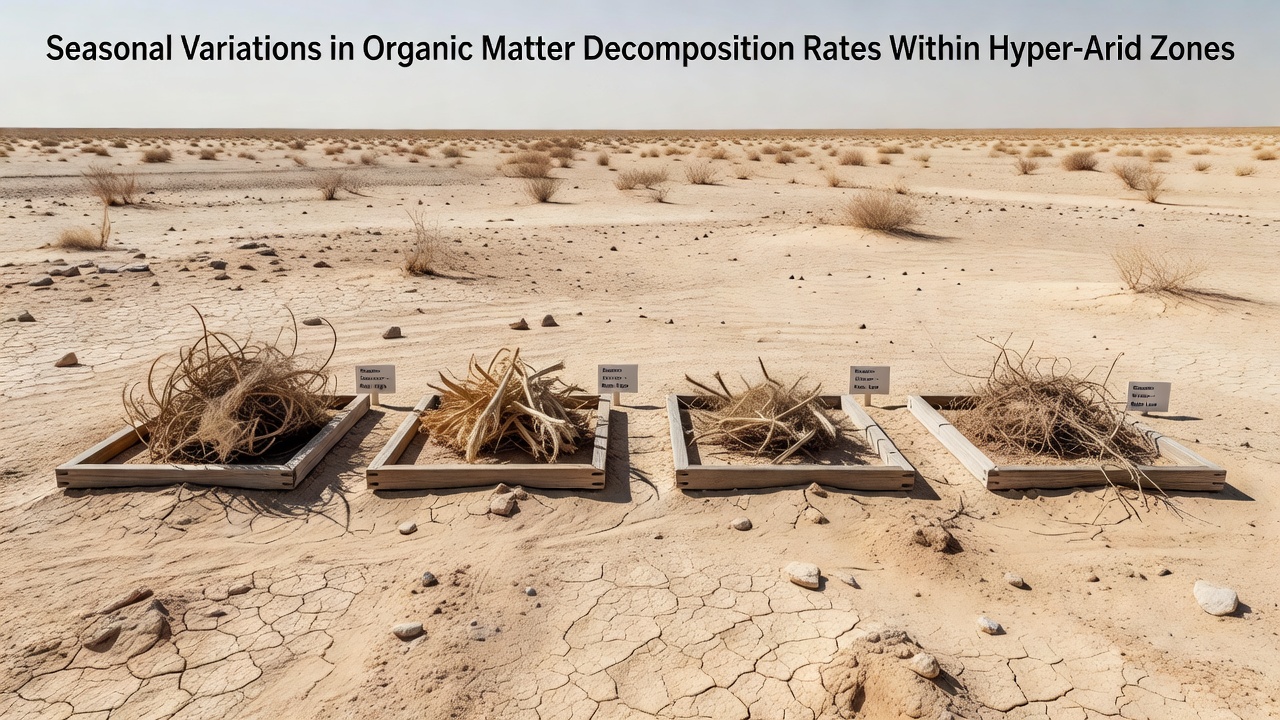
Hyper-arid zones such as the Atacama Desert and parts of the Namib receive less than 50 millimeters of annual precipitation on average, yet organic matter decomposition still occurs through distinct seasonal pulses driven by temperature fluctuations and infrequent moisture inputs. Researchers track these patterns using field sensors and laboratory incubations that measure carbon dioxide efflux as a proxy for microbial activity, and data collected across multiple sites reveal clear differences between cooler winter months and hotter summer periods when metabolic rates shift accordingly.
Key Environmental Drivers of Decomposition
Temperature and sporadic rainfall interact in these environments because hyper-arid soils experience extreme diurnal swings that can exceed 30 degrees Celsius, which in turn affects enzyme function within microbial communities. Organic substrates including plant litter and animal remains persist for years until a precipitation event arrives, after which decomposition accelerates rapidly for days or weeks before returning to baseline levels. Observers note that wind redistribution of fine organic particles also contributes to seasonal variability since stronger gusts during transitional months concentrate material in sheltered microhabitats where microbes can access it more readily.
Patterns Observed Across Different Seasons
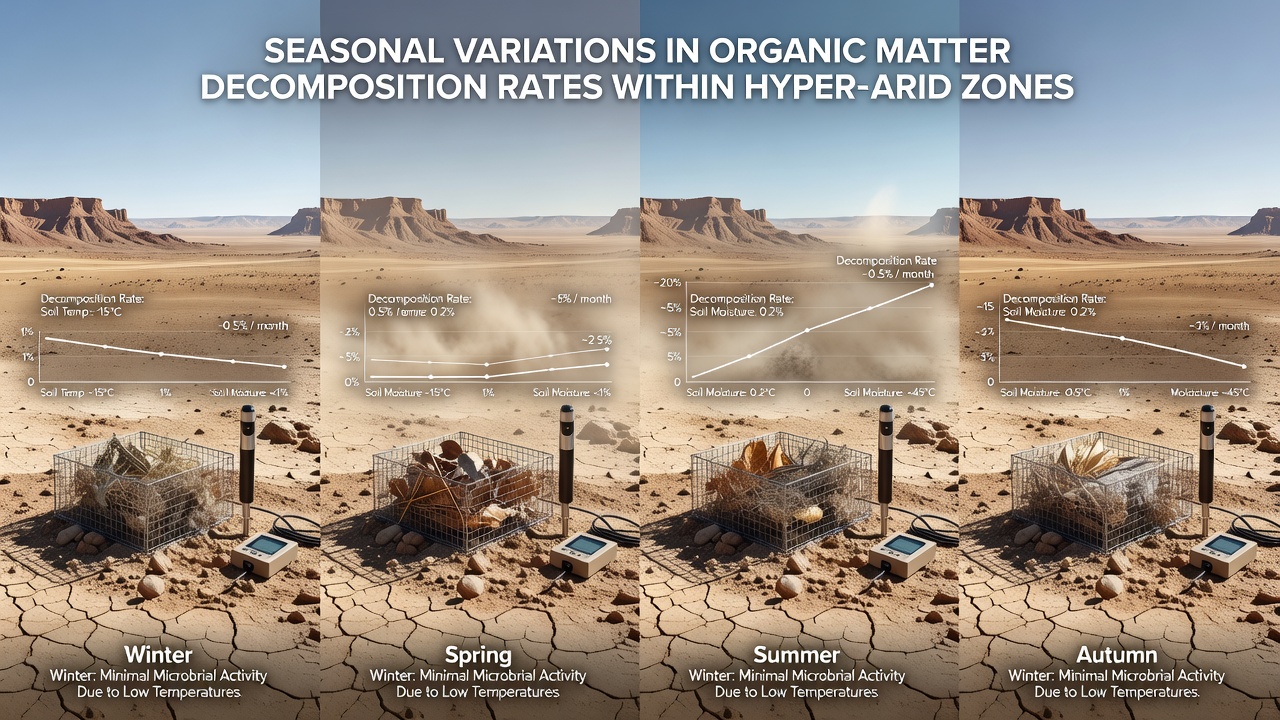
Winter months often produce slower baseline rates because lower temperatures reduce microbial respiration even when minimal dew forms on surfaces, while summer brings higher potential activity that remains constrained until rare storms deliver enough water to activate dormant populations. Studies conducted in the Namib Desert show that a single 10-millimeter rain event can elevate decomposition rates by factors of five to ten for up to three weeks, after which rates decline sharply as soils dry. In contrast, the Atacama region experiences occasional fog events during specific seasons that supply trace moisture without measurable precipitation, and these events support limited but measurable breakdown of buried organic matter throughout the year.
As of October 2026, expanded sensor networks deployed across multiple hyper-arid basins continue to capture these episodic responses with greater temporal resolution, allowing researchers to correlate exact timing of moisture inputs with subsequent carbon release curves. The data indicate that interannual variability in storm frequency creates noticeable differences in cumulative annual decomposition, with years containing two or more events showing substantially higher total carbon turnover than drier intervals.
Microbial Community Responses
Microbial taxa adapted to hyper-arid conditions survive extended dry periods in dormant states and resume activity once water activity reaches critical thresholds, typically around 0.6 water activity units. Different functional groups dominate during distinct phases because bacteria capable of rapid growth respond first to moisture pulses, whereas fungi often persist longer into the drying phase and contribute to later-stage breakdown of more recalcitrant compounds. Research indicates that seasonal temperature regimes also shape community composition, with cooler periods favoring certain psychrotolerant species that maintain low-level activity even under limited hydration.
Measurement Techniques and Recent Findings
Scientists employ a combination of in-situ chambers, stable isotope tracing, and metagenomic sequencing to quantify rates and identify responsible organisms. Results from long-term monitoring programs demonstrate that decomposition rates in hyper-arid zones average between 0.1 and 0.5 grams of carbon per square meter per year under baseline conditions, yet these values can increase by an order of magnitude immediately following moisture availability. CSIRO data collected across Australian arid zones further confirm that seasonal timing of precipitation events influences not only total carbon loss but also the proportion of organic matter converted to stable soil carbon versus released as carbon dioxide.
Additional observations from sites in northern Chile reveal that wind-driven redistribution during spring and autumn months concentrates organic fragments in depressions where subsequent moisture accumulates more effectively, creating localized hotspots of activity that elevate landscape-scale averages. Those who've examined soil profiles across elevation gradients within the same hyper-arid basin find that slightly cooler highland locations exhibit modestly higher winter decomposition compared with lowland areas, illustrating how microclimatic differences interact with broader seasonal cycles.
Implications for Carbon Cycling Models
Updated carbon cycling simulations now incorporate seasonal pulse dynamics rather than assuming constant low rates, and these refinements improve predictions of long-term carbon storage in desert soils. United States Geological Survey reports on arid land soils emphasize that accurate representation of episodic decomposition events is essential for estimating regional contributions to global carbon budgets. The patterns observed in hyper-arid zones also inform understanding of how future changes in precipitation frequency might alter overall turnover without necessarily increasing total annual rainfall.
Conclusion
Seasonal variations in organic matter decomposition within hyper-arid zones arise from the interplay of temperature regimes, sporadic moisture inputs, and microbial adaptations that respond rapidly once conditions allow. Ongoing monitoring through October 2026 and beyond continues to refine quantitative estimates of these processes across diverse desert landscapes, providing essential data for improved ecological and biogeochemical models. The evidence accumulated to date demonstrates that even environments receiving minimal precipitation exhibit measurable seasonal dynamics that shape carbon persistence and release over time.