Mara Hughes · 5 November 2026
Mapping Fungal Spore Survival Strategies Across Barren Landscapes to Timestamped Verification Protocols in Ecological Databases
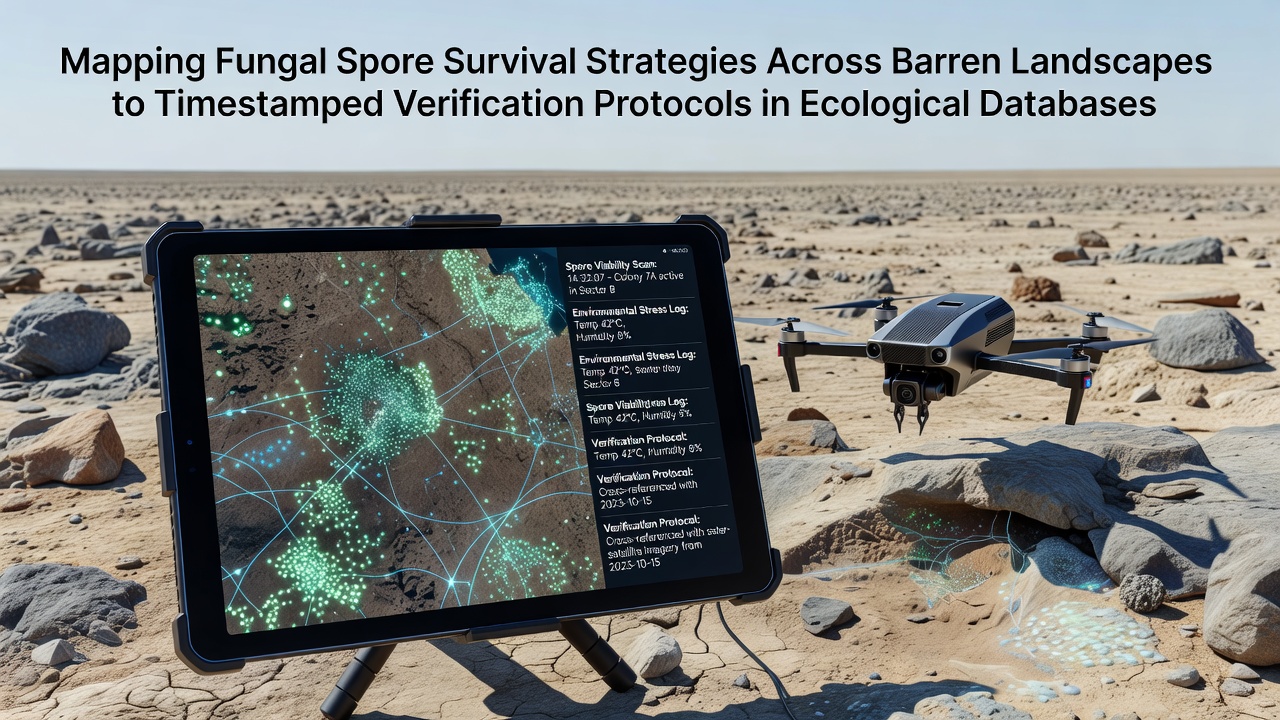
Researchers have documented how fungal spores endure extreme desiccation and temperature swings in barren landscapes through specialized dormancy mechanisms that preserve viability for decades. These same survival patterns now inform the design of timestamped verification protocols used in ecological databases to maintain record integrity over extended periods. Data from field studies in regions such as the Namib Desert and the Atacama show spores reactivating when moisture returns, a process that parallels how archived environmental entries regain accessibility through verified timestamps. Observers note that this biological resilience supplies direct analogies for systems that must confirm data authenticity without constant human intervention.
Fungal Spore Adaptations in Hyper-Arid Zones
Studies conducted across multiple continents reveal that certain ascomycete and basidiomycete species produce spores with thickened cell walls containing trehalose and melanin compounds. These components reduce water loss and shield genetic material from ultraviolet exposure. In the Mojave Desert researchers recorded spore samples remaining viable after 25 years of burial in surface soils that receive less than 50 millimeters of annual precipitation. The same investigations tracked reactivation sequences triggered by brief rainfall events, during which spores germinate within hours and form mycorrhizal associations with pioneer plants. Australian field teams working with the Commonwealth Scientific and Industrial Research Organisation have mapped similar patterns in spinifex grasslands where spore banks contribute to post-drought recovery cycles documented in long-term monitoring plots.
Timestamped Verification in Ecological Data Systems
Ecological databases maintained by agencies including the United States Geological Survey and the European Environment Agency employ cryptographic timestamps to certify the creation and modification dates of sensor readings and species occurrence records. These protocols embed hash values at fixed intervals so that subsequent audits can detect any alteration. When records remain untouched for years the timestamp chain provides evidence that entries have not been rewritten. Implementation guidelines published by Environment and Climate Change Canada specify that each verified block must reference both the previous hash and a trusted time source, creating an unbroken sequence that mirrors the layered protection found in dormant spore structures. Updates scheduled for November 2026 will expand these chains to include satellite-derived vegetation indices from additional orbital platforms.

Direct Correspondences Between Biological and Digital Strategies
Analysts have identified several functional parallels. Spore wall compounds that prevent desiccation correspond to encryption layers that prevent unauthorized data access. The metabolic shutdown that allows spores to persist without nutrients aligns with database states that enter low-energy archival modes while retaining verification metadata. Reactivation upon moisture arrival finds an analogue in query-triggered restoration of timestamped records that remain dormant until accessed. One collaborative project between the University of Arizona and the South African National Biodiversity Institute tested these correspondences by importing spore viability timelines into a prototype verification module. The resulting system flagged any record whose timestamp sequence deviated from expected intervals with the same sensitivity that laboratory assays detect compromised spore membranes.
Implementation Across Global Monitoring Networks
National programs now integrate fungal spore distribution layers into existing environmental repositories. In Canada the National Ecological Monitoring program added spore bank density estimates to its permafrost monitoring stations beginning in 2024. European networks coordinated by the Joint Research Centre incorporated similar datasets into the European Soil Data Centre to improve predictions of post-fire recovery. These additions rely on timestamp protocols that record each new layer at the moment of ingestion so that future users can reconstruct the exact sequence of observations. Field teams upload raw counts from soil cores alongside GPS coordinates and the system automatically generates the next timestamp block. The approach reduces manual reconciliation steps while preserving an auditable history that spans multiple decades.
Conclusion
Mapping fungal spore survival strategies onto timestamped verification protocols supplies ecological databases with tested biological templates for long-term record preservation. Field measurements from arid zones continue to refine the parameters used in hash-chain design, while database operators adopt the same principles of layered protection and conditional reactivation. As monitoring networks expand through November 2026 and beyond, these correspondences offer a practical framework for maintaining both biological and digital continuity across barren landscapes.