Clara Richter · 10 September 2026
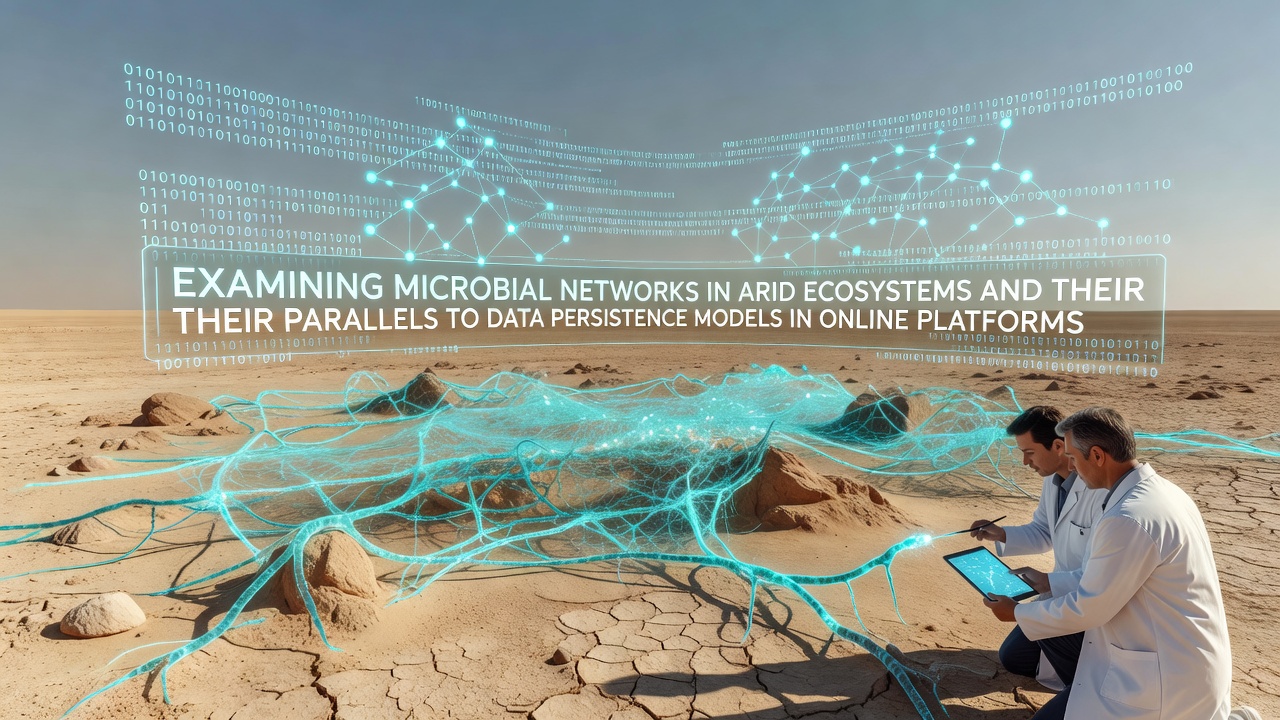
Examining Microbial Networks in Arid Ecosystems and Their Parallels to Data Persistence Models in Online Platforms
Mapping the Basics of Microbial Resilience
Arid ecosystems support microbial communities that form intricate networks capable of surviving prolonged drought, extreme temperature swings, and limited nutrient availability, and researchers have documented how these organisms create symbiotic relationships that recycle scarce resources through biofilms and extracellular polymeric substances. Studies from institutions such as the United States Geological Survey reveal that bacterial and fungal species coordinate via quorum sensing to maintain metabolic activity even when water activity drops below critical thresholds, while similar patterns appear in data persistence models where nodes in distributed systems retain information across hardware failures and network partitions through replication protocols and consensus algorithms. Observers note that both systems prioritize redundancy because single-point failures would collapse the entire structure, and evidence from field sampling in the Mojave Desert shows microbial mats preserving genetic material in dormant states that reactivate upon rare rainfall events.
Network Architecture in Harsh Conditions
Those who study desert microbiology report that microbial networks rely on hub species acting as connectors between otherwise isolated patches of soil, which allows information exchange in the form of metabolites and genetic elements to flow across vast distances despite physical barriers like sand dunes and rocky outcrops. Data persistence frameworks in online platforms mirror this setup when they designate certain servers or clusters as central relays that coordinate updates across edge devices, ensuring that cached copies remain consistent even if primary sources go offline temporarily. Research indicates that these parallels extend to recovery mechanisms, because microbial communities employ sporulation and cyst formation to endure multi-year dry spells, whereas distributed databases use snapshotting and log replay techniques to restore state after outages. One study published in ecological journals tracked how desert cyanobacteria transfer fixed nitrogen to neighboring heterotrophs through shared hyphal networks, and this process echoes how blockchain ledgers propagate transaction data across validator nodes to achieve eventual consistency without central authority.
Resource Allocation and Persistence Strategies
Experts examining arid zones have found that microbial consortia allocate limited carbon sources preferentially to stress-response pathways, which enables long-term survival by sacrificing short-term growth rates during periods of extreme scarcity. Parallel behaviors surface in online data systems where algorithms prioritize write-ahead logging and checkpointing to safeguard critical records over less essential cache entries when storage capacity or bandwidth becomes constrained. Figures from long-term monitoring sites in the Australian outback demonstrate that microbial biomass can remain stable for decades through these efficient partitioning methods, and computer scientists observe comparable stability in cloud storage architectures that employ erasure coding to distribute data shards across geographically separated facilities. What's interesting is how both domains handle information decay: microbes repair DNA damage accumulated during desiccation using specialized enzymes, while data persistence protocols implement checksum verification and automatic repair routines to correct bit rot or corruption in archived files.

Adaptation Patterns Across Scales
People analyzing ecosystem dynamics note that microbial networks in arid regions scale their connectivity based on environmental cues such as soil moisture gradients, which creates modular clusters that can operate independently when larger connections break during sandstorms or heatwaves. This modularity finds direct correspondence in sharded database designs used by major platforms, where individual shards continue processing queries even if inter-shard communication fails due to regional outages. Data from satellite-linked sensor arrays deployed in the Namib Desert since the early 2010s shows periodic surges in microbial activity following fog events, and these surges parallel traffic spikes in content delivery networks that trigger automatic cache warming across multiple availability zones. Observers further highlight that genetic diversity within microbial populations provides raw material for rapid adaptation to changing aridity levels, just as versioned data schemas in persistence layers allow applications to evolve without losing backward compatibility with older records.
Emerging Research Directions Through 2026
Projects coordinated by international teams are scheduled to release comparative datasets in September 2026 that quantify network resilience metrics across both biological and digital domains, and preliminary findings suggest shared mathematical models based on graph theory can predict failure thresholds in each system. Those tracking these developments point to experiments where desert soil samples subjected to simulated climate shifts exhibited reorganization patterns similar to load-balancing adjustments in online platforms during peak demand periods. Such work draws on measurements collected from multiple continents, including Canadian boreal-desert transition zones and European semi-arid research stations, to build cross-domain simulations that test persistence under compounded stressors like combined drought and cyberattack scenarios.
Conclusion
Comparative analysis of microbial networks in arid ecosystems and data persistence models in online platforms demonstrates convergent strategies for survival under constraint, including distributed connectivity, redundant storage of critical information, and adaptive resource allocation. Continued integration of ecological field data with computational modeling offers pathways for refining both natural resource management and digital infrastructure design, and the September 2026 research releases are expected to provide additional quantitative benchmarks that strengthen these interdisciplinary connections.