Rafael Hoffmann · 19 November 2026
Bacterial contributions to humus accumulation in gypsum deserts under fluctuating moisture conditions
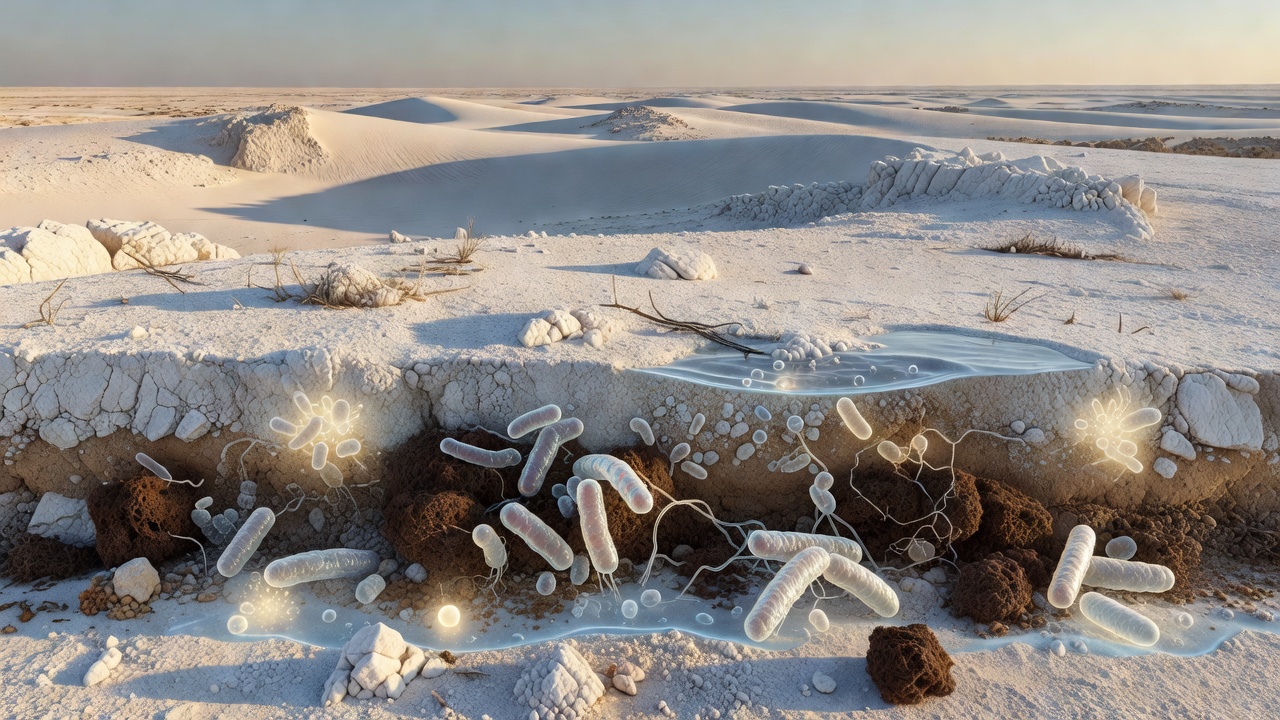
Gypsum deserts present extreme conditions where soil formation depends heavily on microbial processes that respond to irregular water availability, and bacteria play a central role in building humus through organic matter transformation during brief wet periods followed by extended dry phases. These environments, found in regions such as the Chihuahuan Desert and parts of the Middle East, feature soils dominated by calcium sulfate dihydrate that limit plant growth yet support specialized microbial communities adapted to survive desiccation and reactivate quickly when moisture arrives.
Environmental Context of Gypsum Deserts
Gypsum-rich landscapes experience temperature swings and precipitation events that rarely exceed a few millimeters at a time, creating repeated wet-dry cycles that drive biochemical reactions in the topsoil layers. Researchers note that these cycles concentrate dissolved organic compounds near crystal surfaces where bacteria can access them during hydration events lasting only hours or days. Studies conducted across multiple sites show that gypsum particles themselves influence pH and ion availability, which in turn shapes which bacterial taxa dominate the community and how efficiently they process carbon inputs from sparse vegetation or atmospheric deposition.
Key Bacterial Groups and Their Functions
Actinobacteria and certain Proteobacteria strains thrive in these settings because they produce protective spores and extracellular polymeric substances that retain water and enzymes during drying. Data collected from gypsum outcrops indicate these organisms contribute to humus by breaking down plant residues into stable humic acids and fulvic acids that bind to mineral surfaces. Nitrogen-fixing species further support accumulation by converting atmospheric nitrogen into forms that sustain additional microbial growth, thereby increasing overall organic matter inputs over successive moisture events.
Mechanisms During Moisture Fluctuations
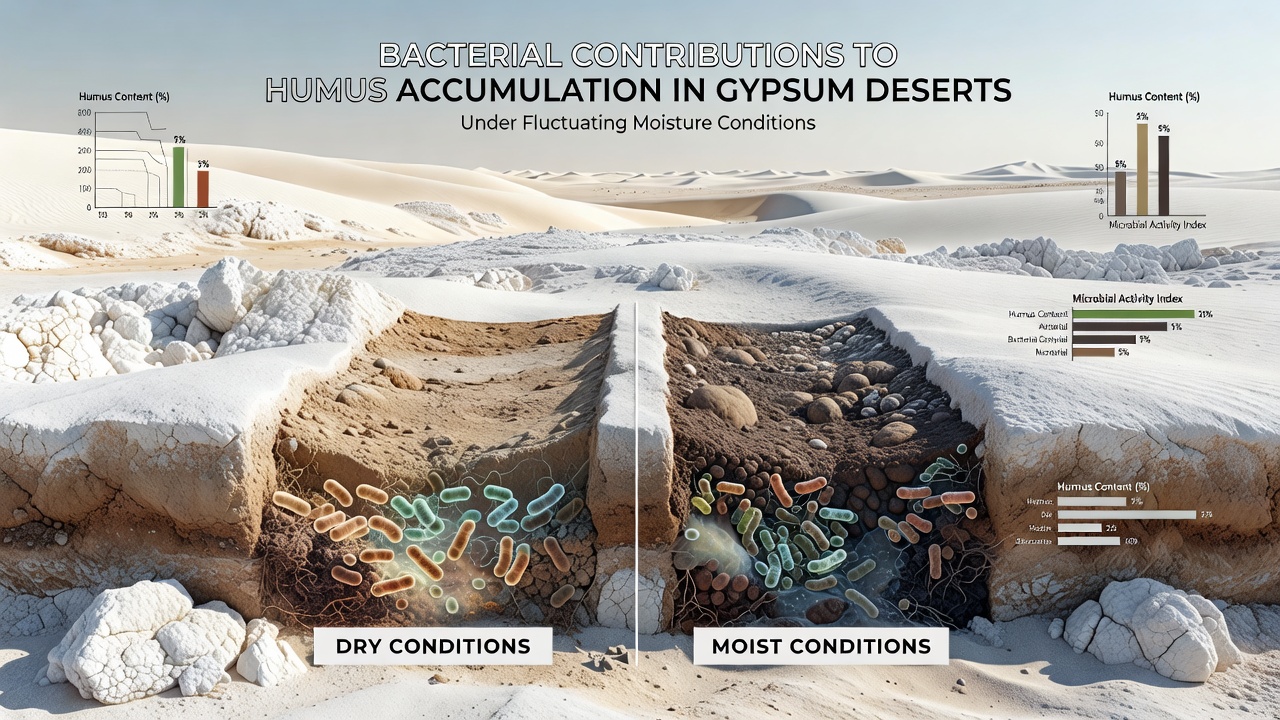
When rainfall reaches the desert surface, bacterial metabolism accelerates within minutes as cells rehydrate and resume enzyme activity that depolymerizes complex organics into smaller molecules. These compounds then undergo condensation reactions that form recalcitrant humus structures resistant to further degradation once the soil dries again. Observers note that the speed of this transition prevents complete mineralization, allowing a portion of carbon to stabilize as humus rather than returning to the atmosphere as carbon dioxide. Repeated cycles amplify the effect because each wetting phase adds incremental layers of microbial byproducts that coat gypsum crystals and create micro-aggregates.
Evidence from long-term monitoring stations reveals seasonal patterns where spring and autumn rains trigger the highest rates of humus formation, while summer heat suppresses activity until the next moisture pulse. Bacterial extracellular enzymes remain active in thin water films even as bulk soil moisture drops below measurable levels, sustaining slow but continuous transformation of organic substrates.
Research Findings from Field Studies
Investigations in gypsum-dominated basins have quantified bacterial biomass increases of several orders of magnitude within 48 hours of wetting, correlating with measurable rises in soil organic carbon content over multi-year periods. A collaborative project involving Australian arid-zone researchers documented similar patterns in comparable sulfate-rich soils, confirming that moisture fluctuation frequency directly controls the balance between organic matter stabilization and loss. Additional work from European soil science groups has examined how bacterial community composition shifts across wetting gradients, linking specific taxa to higher humus yields under intermediate moisture regimes rather than constant dryness or saturation.
One study tracked organic matter dynamics across three consecutive wet-dry cycles and found that bacterial necromass accounted for a substantial fraction of newly formed humus, because dead cells and their polymeric remains resist decomposition once embedded in gypsum matrices. This process operates alongside abiotic oxidation but depends on living bacterial populations to initiate the molecular rearrangements that produce stable humic substances.
Implications for Soil Carbon Storage
Accumulated humus in gypsum deserts improves water retention and nutrient holding capacity, which can support limited plant establishment during favorable years and create feedback loops that further enhance bacterial activity. Figures from regional surveys show that sites with higher bacterial diversity maintain greater humus stocks despite identical gypsum content and precipitation totals. These observations suggest that microbial contributions scale with the number and intensity of moisture fluctuations rather than total annual rainfall alone.
Conclusion
Bacterial processes under fluctuating moisture conditions drive measurable humus accumulation in gypsum deserts through rapid activation during wetting events, production of stable organic compounds, and protection of microbial residues within mineral matrices. Ongoing monitoring continues to refine understanding of these interactions across different gypsum desert systems worldwide.